
The Drawer That Rattled: The 8 Things That Fixed Our Charging
A kitchen drawer full of mystery cables and plugs we could not name. The weekend we emptied it, tested everything and gave every device a known cord and brick.
8 products8 min read
The drawer we didn’t open
Every flat has the drawer. Ours was in the kitchen, second from the top, and it rattled when you walked past. Inside were, by rough count, eleven cables, five wall plugs, two of those little plug adapters for countries we no longer remember visiting, and a micro-USB cord from a printer we had sold in 2022.
The reason we finally dealt with it was small: a phone that charged to forty percent overnight, on a cable we had fished out of that drawer because the good one was in the other room. One of us said the sentence “which one is the good one?” and neither of us knew.
So we gave it a weekend. Friday night to test, Saturday to buy and plug in, Sunday to put the rest away. Here is what we used, in the order we needed it.
Friday night — the audit
We emptied the drawer onto the kitchen table and lined the cables up like suspects. Some we could rule out by eye: the frayed one, the one with the bent plug, the printer cable. The rest all looked the same, and that was the problem. A USB-C cable that charges slowly looks exactly like one that charges fast.
The little meter that told us the truth
The ATORCH USB-C PD power meter, about $13, is a small block with a screen that sits between the charger and the cable and shows the volts and amps actually passing through. We plugged a phone in through each cable in turn. The good ones read around three amps. Two read under one amp, which explained the forty percent. One read nothing at all, which explained a different evening. In twenty minutes we had sorted eleven cables into four we’d keep and seven we wouldn’t. The screen is small and the menu takes a few presses to learn; it also tells you what a cable is doing, not whether a no-name wall plug is safe, which is a different question we answered by throwing the no-name plugs away.

ATORCH USB-C PD Power Meter (Voltage and Current Tester)
$13.29
The three identical cables
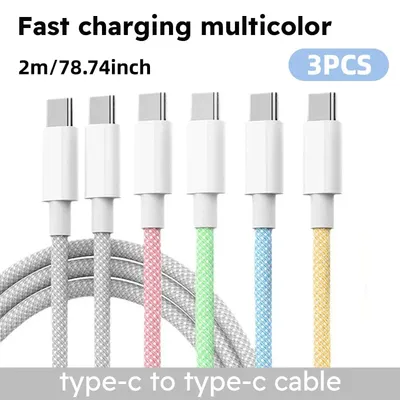
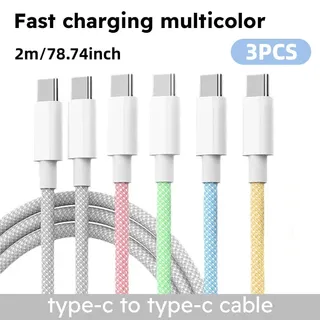
The braided USB-C fast charge cables, about $17 for a three-pack of six-foot cords, were the only cables we ordered. The idea was simple: if every cable in the house is the same cable, nobody has to remember which one is the good one. One went by the bed, one on the desk, one in the bag. They are rated to 60 watts, which charges a phone, a tablet and our small laptop at full speed; a big laptop that wants 100 watts will charge on them, slowly. Six feet is long for a bedside and right for a desk; we have not minded the slack.
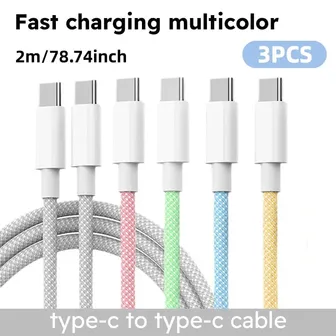
Braided USB-C Fast Charge Cables, 6 ft (3-Pack, 60W)
$16.69
We went to bed with four old cables, three new ones in a box, and a bin bag. Saturday was for the plugs.
Saturday morning — one proper charger per room
The five wall plugs on the table were the part that had worried us. Two had logos we recognised. Three did not, and one of those had been charging a phone next to a pillow for a year. Our rule for the day was that every charger in the flat should be one we could name, and that each room where things charge should have exactly one.
The desk’s single plug
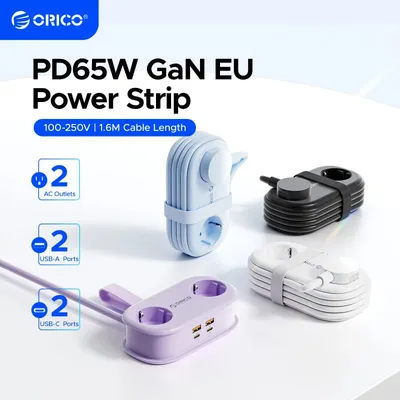
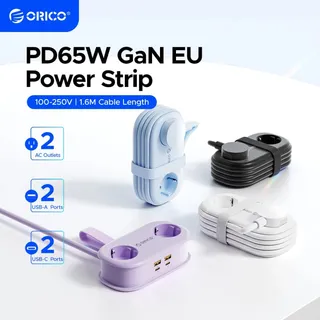
The ORICO Cable-Wrap 65W GaN power strip, about $40, is a block the size of a bar of soap with two mains sockets, two USB-A ports and two USB-C ports, and a cord that wraps around its own body. It went behind the desk and became the one thing plugged into the wall there: the laptop charges from one USB-C port, the phone from the other, the monitor and the lamp from the sockets. The 65 watts is shared, so with the laptop and phone both charging each gets less than the full rate; in practice the laptop still filled up over lunch. It comes in regional plug versions, so pick the one that matches your wall before ordering.
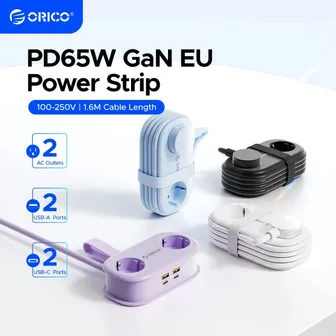
ORICO Cable-Wrap 65W GaN Travel Power Strip
$40.39
The brick that replaced the pile of adapters
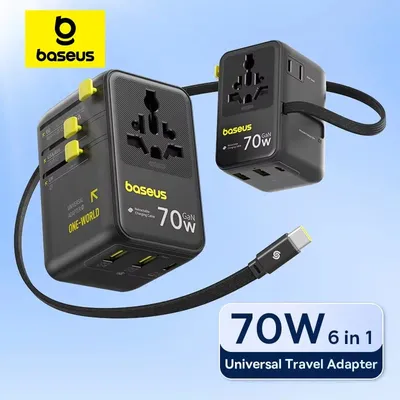
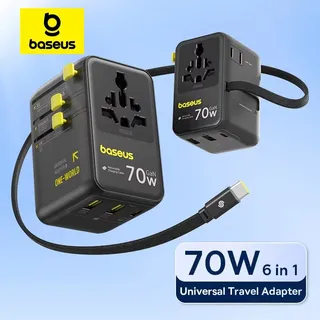
The Baseus 70W GaN universal travel adapter, about $45, is the item we argued about. It is a travel adapter — it fits sockets in most countries — with a USB-C cable that pulls out of the body on a reel, plus two more USB ports and a mains socket on the back. It replaced the two little plug adapters in the drawer, the spare phone charger, and the cable we always forget to pack, all at once. It is bulky for a bedside table and expensive if you never leave the country. We travel a few times a year, and it has already saved us one hotel-room hunt for a socket that fit. It lives in the bag, not by the bed.
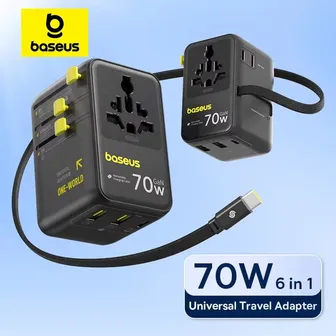
Baseus 70W GaN Universal Travel Adapter (Retractable Cable)
$44.54
By noon the desk had one plug and the bag had one brick. The bedroom was the room we’d been avoiding.
Saturday evening — the bedside
Behind the bed was a single wall socket with a two-way splitter in it, a lamp in one side and a phone charger in the other, and a cable that ran across the floor to whichever side of the bed had the phone that night. It had been like that since we moved in.
The strip that gave the bed two sides
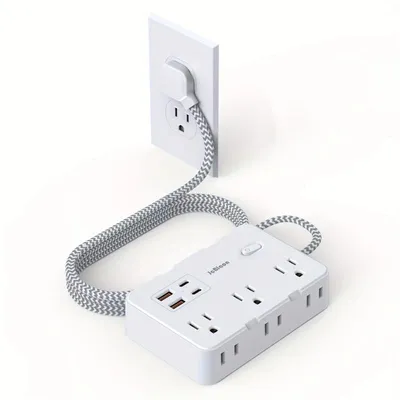
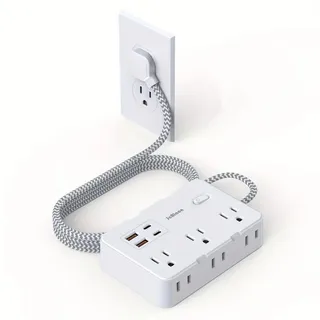
The US power strip with a braided extension cord, about $14, has a short braided cord, several mains sockets and USB ports on the top, and a flat enough body to sit on the floor under the bedside table. The lamp, the e-reader and the new bedside cable all plug into it, and the splitter went in the bin. The braided cord is nicer to look at than a plain one and no stronger; the switch on top glows faintly at night, which one of us likes and the other covers with a book. It is a US-plug strip, so it is the one item here that will not travel.
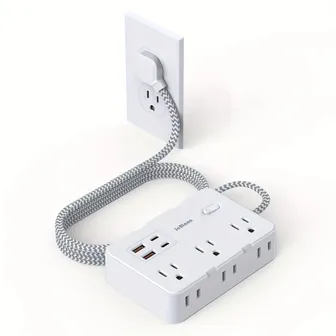
US Power Strip with Braided Extension Cord and USB Ports
$14.05
With the bedroom done we had three rooms with one known charger each and a kitchen table with a small pile of things we were keeping and a larger pile we were not. Sunday was for the pile.
Sunday — the drawer and the bag
The drawer could not stay a drawer. We’d learned that cables loose in a drawer become a drawer of mystery cables within a year, however good they were going in. The fix was two bags and a label.
The case that holds everything we don’t use every day
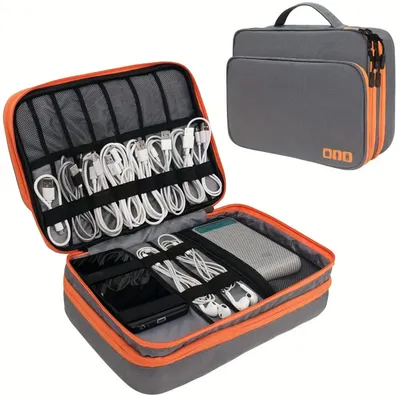
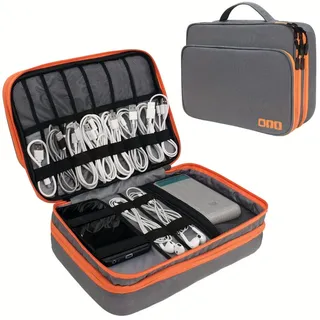
The multi-layer cable and charger storage bag, about $14, is a zipped grey case the size of a hardback book, with elastic loops for cables on one layer and mesh pockets for chargers and a power bank on the other. The four surviving old cables, the laptop brick we already owned, the spare earbuds and the little meter all went in, and the case closed. It went back in the drawer, which no longer rattles, because a case does not rattle. It is too big to take anywhere; that was never the point.
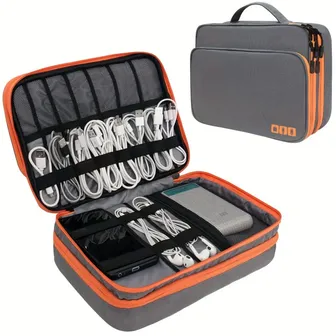
Multi-Layer Cable and Charger Organiser Bag
$14.49
The pouch that goes in the bag
The Hagibis electronics organizer pouch, about $11, is the small version: a zipped pouch with a couple of loops and a pocket, big enough for the Baseus brick, one of the three new cables and a pair of earbuds. That is the entire travel kit now, and it lives in the laptop bag permanently. The brick with its cable fills it, which is a feature — there is no room to add things, so we don’t.

Hagibis Hard-Shell Electronics Case
$10.85
The label maker we didn’t need and used immediately
The Niimbot D110 mini thermal label maker, about $26, prints small sticky labels from a phone app over Bluetooth, no ink. We bought it for one job: putting “60W”, “BED”, “DESK” and “BAG” on the new cables and a name on every charger, so the next time someone asks which one is the good one, the answer is written on it. It is a luxury. Masking tape and a marker do the same job. But the labels have survived six months of being wound and unwound, and the drawer still has no mystery in it. Only the maker’s own label rolls fit, and they are a consumable.

Niimbot D110 Mini Thermal Label Maker
$26.39
The drawer now holds one grey case and a box of labels. The phone charges to a hundred percent overnight, on a cable that says BED on it. It took one weekend and about $181, and most of that was the two chargers.
What we’d leave at home
Everything in this story

ATORCH USB-C PD Power Meter (Voltage and Current Tester)
$13.29
Braided USB-C Fast Charge Cables, 6 ft (3-Pack, 60W)
$16.69
ORICO Cable-Wrap 65W GaN Travel Power Strip
$40.39
Baseus 70W GaN Universal Travel Adapter (Retractable Cable)
$44.54
US Power Strip with Braided Extension Cord and USB Ports
$14.05
Multi-Layer Cable and Charger Organiser Bag
$14.49

Hagibis Hard-Shell Electronics Case
$10.85

Niimbot D110 Mini Thermal Label Maker
$26.39
Everything here comes to about $181. Prices in USD; they move a little from week to week.



Frequently asked questions
How do I sort out a drawer full of old charging cables?
Empty it onto a table, test every cable with a cheap inline USB meter, and throw away anything that reads below two amps or does not read at all. Then buy a small set of identical cables and one proper charger per room. Our whole rebuild came to about $181, and the testing and the cables were about $30 of it.
Are cheap USB-C cables safe to use?
A braided cable from a listing that states its wattage and is sold in a multi-pack is generally fine for phones and tablets. The risk is in the no-name wall bricks, not the cords; that is why we replaced every charger we could not identify and kept the one proper laptop brick we already had.
Do I need a GaN charger?
If you want one block to charge a laptop and a phone from one socket, yes. GaN just means the charger is smaller and runs cooler for the same wattage. The power strip in this story puts 65 watts of USB charging and two mains sockets in a block the size of a bar of soap.
What should go in a cable bag for travel?
One charger that handles the laptop and the phone, two identical USB-C cables, earbuds, and nothing else. The small pouch we use holds exactly that; everything spare lives in a bigger case at home.
How long does shipping take?
Allow two to three weeks. Most of these items ship from overseas and arrive in one to three weeks, so order before the weekend you plan to do the sorting, not during it.